You are currently viewing: Medela - English
You can select an alternative Medela website in one of these countries:

Products Solutions Medela Blog Medela Family Services Customer voices

Breastfeeding Tips

Beyond the latch: the two ways your baby feeds at the breast

Time to read: 4 min.

What is a suction pattern, and why is it important? 

A suction pattern is the natural rhythm your baby uses when feeding: how often they suck, how strong each suck is, and how long they pause in between. Knowing about suction patterns helps you understand why your baby might seem to be 'playing' at the breast, or why you feel your baby isn't sucking strongly enough. In addition, you can make breastfeeding and pumping more efficient. 

Main characteristics of the two primary sucking rhythms (non-nutritive, nutritive) 

Infant suckling is complex; in a single breastfeeding session, babies suck differently when stimulating the breast compared to when they are removing milk. These two distinct phases (or sucking patterns), categorized by their objective in the lactation world, are known as the non-nutritive cycle (for stimulating let-down) and the nutritive cycle (for milk removal). The two cycles significantly differ in their purpose, duration, speed, vacuum strength applied, and, last but not least, what mothers can experience and see from them. In the non-nutritive cycle, infants aim to stimulate the breast. This phase of this cycle is shorter (1-2 minutes), the baby sucks faster but with weaker vacuum. Mothers release no or very little milk. In the nutritive cycle phase, infants transition to an active mode to remove available milk. This kind of sucking takes up the majority  of a breastfeeding session. The babies suck more slowly but with a higher vacuum, reaching their peak vacuum level. As a result, babies actively remove milk. As a mother’s milk flow can increase and decrease throughout the breastfeed (depending on her let-downs) babies will switch between nutritive and non-nutritive cycles as needed. 

Vacuum and its key role during the two main sucking rhythms 

Vacuum strength is of key importance in removing milk. Babies instinctively apply the right level of vacuum during a session, adapting it to their goal: either stimulating the breast or removing milk. In the non-nutritive cycle phase, the vacuum is weaker, while in the nutritive cycle phase, it reaches its peak level. 

The key to efficient milk expression:Maximum Comfort Vacuum 

To understand Maximum Comfort Vacuum, let's look closer at the key elements of a suck during the nutritive cycle, when your baby is actively removing milk. The key steps are: quick build up, long hold, and release. After the quick build up, the vacuum reaches its peak, and this level is highly individual to mothers. However, vacuum isn't the sole factor influencing milk outcome. Studies show that the most effective milk removal occurs only if a higher vacuum does not cause discomfort or pain to mothers. That is why, when pumping, mothers are encouraged to find their ownMaximum Comfort Vacuum. It's good to know that the preferred level of vacuum can change over time: in the early stages of the breastfeeding journey, it is lower and increases later on once breastfeeding is established. 

How pumps mimic the different rhythms, and how to adjust the pumping setting according to the rhythms 

Medela pumps are designed to closely mimic the natural rhythm of baby sucking during a breastfeeding session. To optimize milk removal during pumping, mothers can adjust their pump settings to align with the baby's natural sucking rhythms, switching between modes as needed. 

In the non-nutritive cycle phase, the pump must be in the Stimulation mode, and once milk starts to flow, it needs to be in the Expression mode

Most Medela breast pumps feature 2-Phase Expression technology. This innovative technology mimics your baby's feeding patterns – starting with fast, light sucks to stimulate milk flow, then switching to slower, stronger sucks for efficient milk removal. While the core technology is similar, pumps may slightly differ in how you enable the modes and their level of automation.  

For example, the Symphony® breast pump, featuring the 2-Phase Expression technology, automatically switches to the expression mode after a two-minute stimulation phase, allowing mothers to fine-tune the vacuum level to find their Maximum Comfort Vacuum.

Our innovative FluidFeel Technology™, available in the Medela MagicInBra, offers automated pumping via a built-in flow sensor and will switch to the expression mode after that initial flow of milk is detected. The built-in sensor constantly responds to your milk flow, ensuring the stability of your chosen setting and a comfortable feeling at all times. 

At Medela, researchers continue to study the intricacies of infant sucking, and we are committed to implementing these findings into our innovative technologies and products. Our goal is to empower mothers with the most effective and comfortable pumping solutions, supporting their unique breastfeeding journey. 

What happens during a feeding or pumping session? 


Step 1: Stimulation 

Step 2: Milk Removal (Expression) 

Approx. Duration 

~1–2 min (varies)  

5–37 min (varies with  infant) 

15 min (as target with pump) 


Baby’sSucking Pattern 

Fast and light — may look like ‘fluttering’ or ‘playing’ with the nipple 

Slow and deep — audible swallowing (“ka-lunk” or “gulp”) 

Mother Experiences 

No or little milk flow 

Periods of steady milk flow 

Pump Mode 

Stimulation mode  —  trigger milk to flow 

Expression moderemove milk 

Tip 

As soon as milk starts to flow, switch to expression mode!  

Find your Maximum Comfort Vacuum! 


References

Geddes DT et al. Early Hum Dev. 2008; 84(7):471–477. 

Kent JC et al. BreastfeedMed. 2008; 3(1):11–19. 

Kent JC et al. J Hum Lact. 2003; 19(2):179–186. 

Kent JC et al. Pediatrics. 2006; 117(3):e387-e395. 

Mitoulas L et al. J Hum Lact. 2002; 18(4):353–360. 

Mizuno K, Ueda A. Pediatr Res. 2006; 59(5):728–731. 

Pang WW, Hartmann PE. J Mammary Gland Biol Neoplasia. 2007; 12(4):211–221. 

Ramsay DT et al. J Hum Lact. 2005; 21(4):421–428. 

Sakalidis VS et al. J Hum Lact. 2013; 29(2):236–245. 

Wolff PH. Pediatrics. 1968; 42(6):943–956. 

Woolridge MW. Midwifery. 1986; 2(4):164–171. 

Related Products

Breast Care

Contact™ Nipple Shields

Medela’s Contact™ nipple shields make breastfeeding possible when latching on is difficult or painful by protecting sore nipples and helping your baby attach more easily.

View product
Magic Inbra™, Full Performance, zero compromise
InBra™ electricPumps

Magic InBra™

Medela Magic Inbra™ :  The gentle wearable breast pump for unmatched performance

Meet the next generation breast pump combining unmatched performance, comfort and discretion so mums never have to compromise again. 

View product
Bottles & Bags

Easy Pour Breast Milk Storage Bags

Use the Easy Pour Breast Milk Storage Bags to store your freshly expressed breast milk in freezer or fridge. Our unique spouts make it easy to use and deliver a mess free experience.

View product
Breast Care

Contact™ Nipple Shields

Medela’s Contact™ nipple shields make breastfeeding possible when latching on is difficult or painful by protecting sore nipples and helping your baby attach more easily.

View product
Magic Inbra™, Full Performance, zero compromise
InBra™ electricPumps

Magic InBra™

Medela Magic Inbra™ :  The gentle wearable breast pump for unmatched performance

Meet the next generation breast pump combining unmatched performance, comfort and discretion so mums never have to compromise again. 

View product
Bottles & Bags

Easy Pour Breast Milk Storage Bags

Use the Easy Pour Breast Milk Storage Bags to store your freshly expressed breast milk in freezer or fridge. Our unique spouts make it easy to use and deliver a mess free experience.

View product

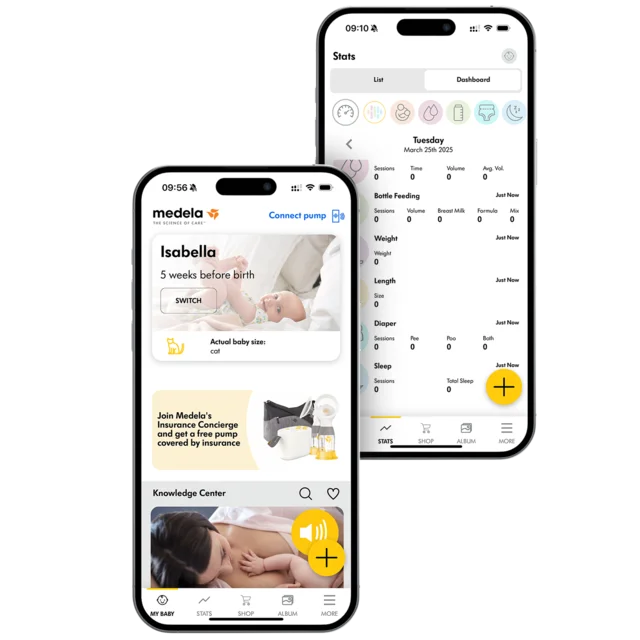
Get the app!

The Medela Family app helps you to keep track of your baby’s needs from pregnancy to nursery.


  • Pregnancy
  • Breastfeeding
  • Pumping

Related Articles

Articles that may be of interest

Breastfeeding Tips

Does More Suction Mean More Milk?

  • Time to read: 4 min.
Read more
Pumping Tips

What’s the difference between open- and closed-system breast pumps?

  • Time to read: 4 min.
Read more
Medela double pumping
Pumping Tips

Double pumping: More milk in less time

  • Time to read: 3 min.
Read more
Breastfeeding Tips

Does More Suction Mean More Milk?

  • Time to read: 4 min.
Read more
Pumping Tips

What’s the difference between open- and closed-system breast pumps?

  • Time to read: 4 min.
Read more
Medela double pumping
Pumping Tips

Double pumping: More milk in less time

  • Time to read: 3 min.
Read more